
Navigating the New Reality of AI: Essential Questions for Organizational Leaders
There have been fundamental shifts in the world of AI. What was once state of the art—even back in January—is now being eclipsed by new models with even more capabilities than before. Anthropic released Claude Opus 4.6 that iterated on their already impressive 4.5 model released back in November. 4.6 was able to code an entire compiler, or a computer code translator, fully autonomously in 2 weeks. That’s not a human constantly going back and interacting with the model and correcting mistakes. That’s Claude going off and handling everything from one prompt.
Now the focus here is not to go tout the accomplishments in the industry going on at this time, but instead to really step back and think about the big picture and ask some important questions. These are some of the most common questions we hear in our conversations with city and business leaders, employees, and the general public. So that’s what we are going to do today, is try to cut through all of the noise and figure out as organization leaders, what should we be focused on now?
As a disclaimer, all of these could easily be lengthy articles on their own, but for the sake of coherence, we believe it’s important to compile them all together as they are related.
The Future of Job Roles
One of the most common fears across all levels of organizations is worrying whether AI will take their jobs. The truth is that many roles will begin to really shift, especially for knowledge workers.
For those unaware, AI agents are essentially digital employees that can do tasks for you including researching from the web or your own proprietary data, drafting emails, or even programming new tools. With the rise of these AI agents, employees will all essentially shift up one rung on their org chart. An entry-level analyst can now delegate his meeting minutes to an AI agent who will attend the meeting and record notes. The senior manager will be able to have AI monitor project progress and create entire presentation decks.
These aren’t future hypotheticals; these are all present realities that are occurring today. What will happen next is the technology diffusion that will permeate into organizations across all sectors.
The speed of this transformation has caught the attention of technology leaders at the highest levels. Jad Tarifi, who founded Google’s first generative AI team, recently warned that pursuing advanced degrees in fields like law and medicine may soon become obsolete. His argument is stark: by the time students complete multi-year degree programs, AI will have caught up—or even surpassed—what the degree is designed to teach. As Tarifi told Fortune, students risk “throwing away” several years of their lives pursuing credentials that AI may render less valuable by graduation.
This isn’t meant to be alarmist, but rather a realistic assessment of how quickly the landscape is changing. The question isn’t whether jobs will be affected, but how organizations can prepare their workforce for this transition.
The Speed of Innovation
Previous innovations in society have all worked more on a relatively linear scale. When the assembly line was introduced by Henry Ford in 1913, it took time before it made its way into other organizations. Ford’s engineers employed Frederick Taylor and his “scientific management” principles, conducting time-and-motion studies to optimize every aspect of Model T production. Through these methodical studies, they reduced assembly time from 12.5 hours to just 93 minutes over an 18-month period—a remarkable 1,308% productivity surge. Yet even this revolutionary improvement unfolded over years as the methodology spread to other industries and continued to iterate.
But with AI, everything is totally different. AI is now able to recursively self-improve, meaning it can be used to improve itself. OpenAI’s new frontier model Codex 5.3 marked a watershed moment when, for the first time, they were able to use it to tweak itself and make noticeable improvements. As OpenAI stated in their blog post: “GPT-5.3-Codex is our first model that was instrumental in creating itself.”
Using the assembly line analogy, this is equivalent to a conveyer belt that instead of being a depreciating asset, figured out ways to maintain itself and move more goods on it. This has a compounding impact on growth. We’re no longer talking about years before you see noticeable improvements. We’re now to the point where if you were just using a model a month ago, it might be drastically outdated.
OpenAI went from their previous Codex release on December 18, 2025, to a much more powerful one in less than two months—compared to frequent gaps of six months or even a year between previous releases. If this pace continues, we could see four major updates in a year. But the implications of recursive self-improvement could be even more radical. As models become capable of updating themselves more rapidly, we might see six updates in the latter part of a year—one per month—accelerating the pace of improvement by five to ten times.
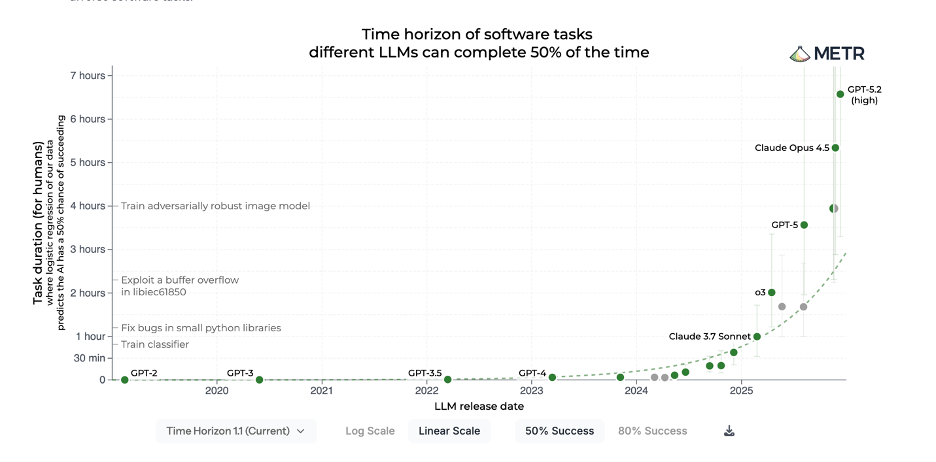
To drive home this point, let’s look at the chart showing how long it takes different AI models to complete software tasks with at least a 50% success rate. Over the course of 2025 alone, we went from tasks that were under an hour to right around 7 hours. This growth extrapolated out over a longer time horizon shows not even hockey stick growth, but flat wall growth. That means that the tasks you were asking AI to do even 6 months ago might not have been possible but today might only require a couple of hours.
What Does This Mean for My Organization?
In line with our balanced approach to all things, we believe organizations are meant to be organic rather than purely rigid structures. Sure, you can have a skeleton, but you also need ligaments that bend. The same principle applies to how we think about AI adoption. If the technology is improving this rapidly, and if job roles are shifting this dramatically, what should organizational leaders actually be doing about it?
The temptation is to either rush headlong into every new AI tool or to freeze and wait for the dust to settle. Neither approach works. Instead, we see three principles that should guide how you think about AI in your organization right now.
First, don’t overly commit to any one model or vendor. What is best in class today genuinely might not be best tomorrow. We’ve seen this play out over and over in the past year alone. The model that was leading the pack in January got leapfrogged by March. The vendor promising to solve all your problems with their proprietary system suddenly looks dated when a new capability emerges that they can’t support. This is why we’re cautious about solutions that try to lock you into specific models or tools—think ServiceNow implementations, direct relationships with a single AI provider like OpenAI, or platforms that are built around one specific model architecture. The pace of innovation we just discussed means that flexibility isn’t just nice to have; it’s the difference between riding the wave and getting stranded on the beach. Your technology stack needs to be model-agnostic, meaning you can swap out the underlying AI as easily as you’d switch suppliers for office furniture.
Second, and this might sound obvious but it gets lost constantly: remind yourself that AI is just part of the equation. Don’t get lost in the noise and make sure to always focus on what problems you are solving. We’ve had conversations with leaders who can tell us everything about the latest GPT release but can’t articulate which specific bottleneck in their organization they’re trying to address. That’s backwards. The most successful implementations we see start with a clear problem—meeting notes are eating up 10 hours a week per analyst, or project status reports are consistently two weeks behind reality—and then find the AI tool that solves that specific thing. Not the other way around. When you start with the technology and then go hunting for problems it might solve, you end up with expensive toys that sit unused or, worse, create more work than they eliminate.
Third, when AI comes in, it can easily upset the balance of your organization, especially considering the fear of job displacement we talked about earlier. This is where our Liora Framework comes in. It’s human-centric and views AI as a force multiplier—something designed to boost your organizational immune system rather than replace it. Think of it like this: when you introduce any new tool, there’s a period where people need to learn how to use it, where workflows get disrupted, where some people adapt faster than others. AI is no different, except the stakes feel higher because of all the public conversation about job loss. If you implement it poorly—rolling it out without explaining how it fits into people’s actual work, without addressing the fear directly, without giving people time to adjust—you create organizational dissonance. People start working around the AI instead of with it. They lose trust in leadership. Productivity actually goes down even though you’ve theoretically given them a powerful new tool. Proper implementation means being transparent about what’s changing and what’s not, providing training that’s actually useful rather than just checking a box, and making it clear that the goal is to make people’s jobs better, not to eliminate them.
Closing
The AI revolution is not coming—it’s already here. The models released in the past few months represent a fundamental shift in capability, and the pace of improvement is accelerating exponentially. For organizational leaders, the challenge is not to predict exactly where AI will be in six months or a year, but instead to build the organizational flexibility, workforce readiness, and strategic framework to adapt as it evolves.
The organizations that will thrive are those that embrace AI as a complement to human capability, maintain agility in their technology choices, and never lose sight of the fundamental problems they’re trying to solve. The future belongs to those who can harness this transformative technology while keeping the human element at the center of their mission.